
Industrial & Marine FRP Products Catalog
Precision-engineered, zero-corrosion composite solutions built to ASTM, BS, and ASME standards for chemical plants, marine ports, water treatment, and heavy industrial facilities.
FRP Chemical Storage & Reaction Process Tanks
Our heavy-duty composite storage tanks are designed and fabricated to ASTM D3299 (Filament Wound), ASTM D4097 (Contact Molded), BS 4994, and ASME RTP-1 specifications. Engineered for aggressive mineral acids, caustics, oxidizing agents, and organic solvents, our tanks eliminate the corrosion and catastrophic leakage associated with carbon steel and rubber-lined vessels.
Every vessel features a monolithic 3-zone laminate construction: an inner 90% resin-rich chemical barrier (100–120 mils thick) reinforced with synthetic polyester/C-glass veils, followed by a high-strength structural backing layer, and an outer UV-inhibited weather barrier.
.jpeg)
FRP Molded & Pultruded Industrial Gratings
Engineered for high pedestrian and vehicular traffic across corrosive industrial walkways, chemical transfer dykes, offshore oil platforms, and wastewater clarifiers. Our gratings feature an integrated quartz-grit top surface achieving the highest slip resistance rating (DIN 51130 Class R13).
Being 100% non-conductive (dielectric breakdown > 35 kV/inch) and non-sparking, FRP gratings eliminate electrocution risks around transformer yards, power plants, and solvent storage facilities.
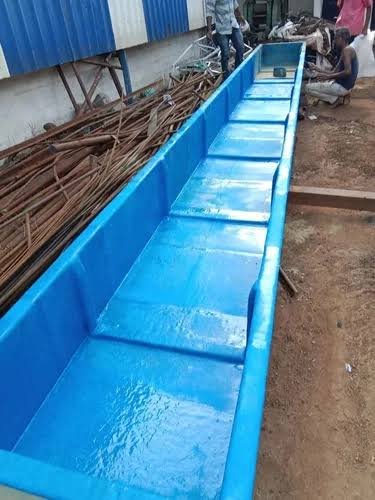
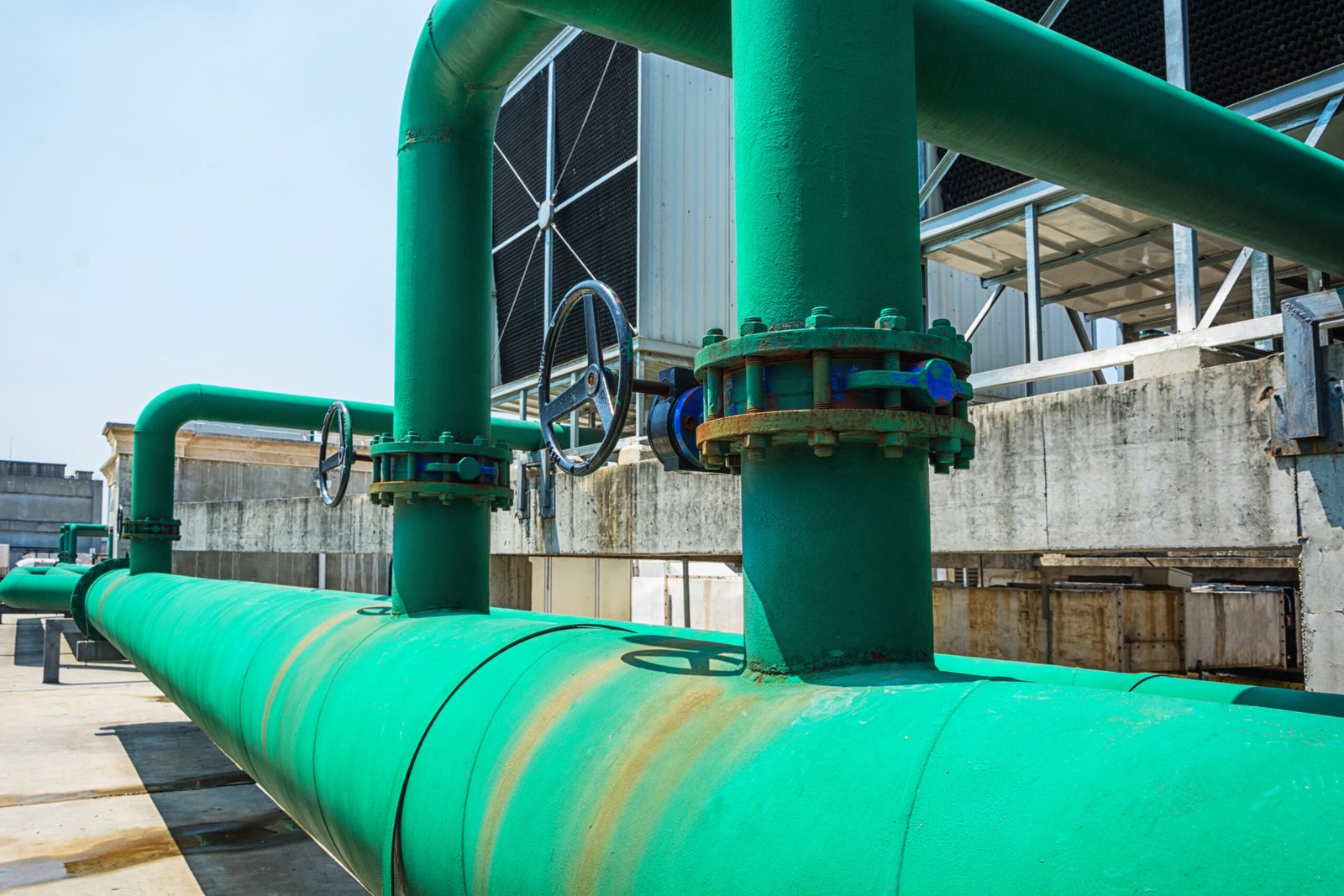
Filament Wound FRP Pipes & Chemical Exhaust Ducts
Automated helical filament winding at balanced 54.7° geodesic angles yields high internal pressure capacity (up to 16 bar) and superior vacuum collapse resistance. With a mirror-smooth hydraulic interior (Hazen-Williams C-factor = 150), our composite piping slashes pumping energy consumption by up to 20% compared to rusted carbon steel lines.
Applications include circulating cooling water lines, flue gas desulfurization (FGD) slurry pipes, sea water intake/outfall headers, chemical effluent lines, and acid vent scrubber ducting.
FRP Pultruded Structural Profiles, Ladders & Handrails
Continuous pultruded structural shapes—including I-beams, wide flange channels, square hollow sections, and safety cage ladders—contain 65%–70% unidirectional glass reinforcement. They deliver the structural strength of steel at one-fourth the weight, completely eliminating structural painting and weld inspections.
Compliant with OSHA 1910.23 standards for worker safety access across chemical processing facilities, port jetties, and water treatment plants.
FRP Heavy-Duty Trench, Drain & Manhole Covers
Our compression moulded FRP drain and chamber covers comply strictly with EN 124 / IS 1726 load ratings (from A15 pedestrian up to D400 heavy commercial highway vehicle duty). Unlike cast iron and ductile iron covers, FRP covers have zero scrap metal theft value, eliminate metallic clattering under wheel impact, and remain 100% rust-free in saltwater and chemical splash environments.
Master Thermoset Resin Selection Matrix
Selecting the exact polymer backbone for chemical concentration, operating temperature, and fire retardancy.
| Resin Polymer Chemistry | Maximum Temp (°C) | Primary Chemical Resistances | Recommended Product Applications |
|---|---|---|---|
| Epoxy Novolac Vinyl Ester | 120°C – 140°C | Concentrated Hydrochloric Acid (37%), H2SO4 (70%), Nitric Acid, Bleach, Solvents | Acid Storage Tanks, Chemical Process Reactors, Pickling Vats |
| Bisphenol-A Vinyl Ester | 105°C – 115°C | Sodium Hydroxide (50%), Sodium Hypochlorite, Chlorine Gas, Organic Acids | Chlor-Alkali Scrubbers, Effluent Piping, Neutralizing Sumps |
| Isophthalic Polyester | 80°C – 95°C | High-Salinity Seawater, Mild Acids, Industrial Wastewater, Potable Water | Molded Walkway Gratings, Seawater Intake Pipes, Marine Boat Decks |
| Fire-Retardant Halogenated Resin | 100°C | Chemical splash + ASTM E84 Class 1 (Flame Spread ≤ 25) | Offshore Platform Gratings, Cable Trays, Transformer Yard Towers |
In-Depth Engineering Specifications for Industrial Composite Product Systems
Detailed mechanical characteristics, structural design standards, chemical barriers, and installation guidelines for plant engineers and project specifiers.
1. Chemical Storage Vessel Engineering (ASTM D3299, BS 4994 & ASME RTP-1)
Industrial storage of aggressive mineral acids (Hydrochloric Acid HCl 30%–37%, Sulfuric Acid H2SO4 up to 70%, Nitric Acid HNO3 up to 20%), chlor-alkali caustics (Sodium Hydroxide NaOH 50%), and oxidizing bleaches (Sodium Hypochlorite NaOCl 15%) requires an engineered multi-barrier laminate. Standard carbon steel vessels require expensive elastomeric rubber lining or lead lining that suffers rapid pinhole blistering, debonding, and under-lining steel wall thinning. Stainless steel alloys (SS304, SS316, and even high-nickel Hastelloys) are prone to chloride pitting corrosion and catastrophic Chloride Stress Corrosion Cracking (CSCC).
Our composite storage tanks are fabricated using automated continuous helical filament winding or contact moulding with a disciplined 3-zone laminate architecture:
- Zone 1: The Inner Chemical Barrier (Corrosion Liner): A 2.5 mm to 3.5 mm thick, 90% resin-rich barrier comprising 1 to 2 plies of synthetic polyester surface veil (Nexus / Dacron) or C-Glass veil (30 gsm each), followed by 2 to 3 plies of 450 gsm Chopped Strand Mat (CSM) wetted out with premium Vinyl Ester Novolac resin (such as Ashland Derakane 470 or Swancor 901). This zone contains less than 15% glass by weight, ensuring maximum resin saturation to prevent micro-capillary chemical ingress.
- Zone 2: The Structural Core Laminate: Designed to withstand internal hydrostatic liquid head pressure, wind vortex shedding to IS 875 Part 3, and seismic overturning moments to IS 1893. Utilizing continuous high-strength E-CR glass filament wound at 54.7° geodesic angles with 55%–65% glass content by weight, delivering ultimate hoop tensile strength exceeding 300 MPa.
- Zone 3: The Exterior Weather Barrier: A 0.5 mm thick isophthalic resin gelcoat containing Hindered Amine Light Stabilizers (HALS) and 0.2% benzotriazole UV absorbers, providing 100% resistance to coastal marine salt mist, aggressive industrial atmospheric fumes, and solar photodegradation.
2. Molded vs. Pultruded Floor Gratings: Load Span Mechanics & Fastening Systems
Flooring and access walkways in chemical processing plants, fertilizer complexes, wastewater clarifiers, and coastal port jetties represent critical safety infrastructure. In aggressive environments containing acid washdown, seawater splash, or organic solvents, traditional hot-dip galvanized carbon steel gratings deteriorate rapidly. The zinc sacrificial layer is consumed within 6 to 18 months, leading to severe rust exfoliation, structural bar thinning, and catastrophic worker punch-through accidents.
Molded FRP Gratings are manufactured in single-piece compression moulds with continuous interwoven E-glass rovings embedded in a thermoset resin matrix. This delivers equal bi-directional flexural strength in both directions. When cut on-site around complex pipe penetrations, valve actuators, or circular tank shells, molded gratings do not require additional structural edge banding or trimming reinforcement.
Pultruded FRP Gratings utilize high-tonnage continuous pull pultrusion with 65%–70% longitudinal glass roving content. Pultruded I-bars and T-bars deliver significantly higher longitudinal flexural modulus (EI stiffness), allowing designers to achieve structural spans up to 1,500 mm to 1,800 mm under standard 5 kN/m² uniform industrial live loads with less than L/200 deflection.
All grating installations are secured using marine-grade 316 Stainless Steel fastening hardware:
- Type M-Clips: Securely clamp two adjacent load bars to underlying structural support beams without drilling through composite bars.
- Type C-Clips: Join abutting panel edges to eliminate differential deflection when heavy rolling loads traverse panel joints.
- Type G-Clips: Friction-clamp grating panels to steel structural flanges without requiring hot-work welding permits.
3. Fluid Dynamics & Friction Head Advantages of Composite Piping Systems
In power plant circulating cooling water (CW) systems, chemical effluent pipelines, and reverse osmosis desalination plants, pumping electrical power represents the single largest ongoing operational expenditure. Metallic piping suffers from internal bio-fouling, tuberculation, and scale deposition that dramatically increases surface roughness over time.
In the Hazen-Williams hydraulic head loss equation, composite FRP piping maintains a constant surface roughness coefficient of C = 150 throughout its 35+ year operating lifespan, whereas unlined carbon steel degrades from C = 120 (new) down to C = 80–90 after just 5 years of service. For a typical 500-meter DN600 cooling water line flowing at 2.5 m/s, the mirror-smooth resin interior of FRP piping reduces total friction head loss by over 28%, resulting in direct recurring electrical energy savings of tens of thousands of kilowatt-hours annually.
4. Dielectric Safety & Non-Sparking Performance in Explosive Zones
In petrochemical refineries (such as HPCL Visakhapatnam), bulk pharmaceutical API solvent recovery plants (JNPCL Parawada), and battery manufacturing facilities, accidental mechanical friction sparks or electrical ground discharge can trigger catastrophic vapor cloud explosions. Standard steel tools, gratings, and stair treads pose continuous spark hazards under impact.
FRP composite structural shapes, gratings, and ladder systems are inherently non-sparking upon impact and provide extraordinary dielectric electrical insulation (dielectric strength exceeding 35 kV/inch). This eliminates electrostatic charge accumulation, prevents stray current galvanic electrolysis, and completely eliminates the need for expensive hazardous-area earthing and bonding conductors across walkway platforms.
Comprehensive Product Sizing, Tolerances, and Installation Guide
Complete technical data for composite piping, chemical vessels, access structures, and cover systems.
5. Chemical Tank Nozzle Engineering & Reinforcement Sizing
Nozzles on FRP process vessels (inlets, bottom outlets, side manways, overflow nozzles, instrument ports) experience significant external piping thrust, bending moments, and thermal expansion forces. Under ASME RTP-1, all nozzle attachments are categorized and reinforced using tailored gusset plates and conical hub overlays.
Our standard nozzle connection designs follow ASME RTP-1 Table 4-1 with minimum nozzle wall thicknesses:
- DN50 (2-inch NB) to DN100 (4-inch NB): Minimum nozzle wall thickness of 6.0 mm with 4-radial triangular gusset reinforcements (minimum 8.0 mm thick) laminated onto the vessel shell with 150 mm taper overlaps.
- DN150 (6-inch NB) to DN300 (12-inch NB): Minimum nozzle wall thickness of 8.0 mm with conical hub reinforcement extending 250 mm from vessel centerline.
- DN500 (20-inch NB) and DN600 (24-inch NB) Manways: Full-bore manway openings with integral heavy-duty flanged covers, 316 SS bolting, and 6.0 mm thick full-face chemical-resistant EPDM or Viton gaskets.
6. Pultruded Structural Profile Mechanical Properties
Pultruded profiles—including Equal Angles, C-Channels, I-Beams, Wide-Flange Columns, and Square Hollow Sections—are engineered to deliver predictable structural load-bearing performance under ASTM D4385 standards. Below are standard design mechanical values used in structural calculations:
- Longitudinal Tensile Strength (ASTM D638): 207 MPa (30,000 psi) minimum.
- Transverse Tensile Strength (ASTM D638): 48 MPa (7,000 psi) minimum.
- Longitudinal Compressive Strength (ASTM D695): 207 MPa (30,000 psi) minimum.
- Longitudinal Flexural Modulus of Elasticity E (ASTM D790): 17,200 MPa (2.5 × 10&sup6; psi).
- Short-Beam Shear Strength (ASTM D2344): 31 MPa (4,500 psi).
- Barcol Hardness (ASTM D2583): 45 – 50.
- Water Absorption 24-hr (ASTM D570): ≤ 0.45% by weight.
7. EN 124 Drainage & Manhole Cover Load Classification Guide
FRP drain and chamber covers are manufactured using high-pressure compression moulding of sheet moulding compound (SMC) or heavy hand-layup resin-rich laminates. Standard load classifications comply with EN 124 / IS 1726:
- Class A15 (15 kN / 1.5 Metric Tonne Test Load): Areas accessible solely to pedestrians and cyclists (pedestrian walkways, garden paths, rooftop drains).
- Class B125 (125 kN / 12.5 Metric Tonne Test Load): Sidewalks, pedestrian zones, and light vehicle parking facilities.
- Class C250 (250 kN / 25.0 Metric Tonne Test Load): Industrial plant service roads, kerbside drainage channels, and factory internal transit lanes.
- Class D400 (400 kN / 40.0 Metric Tonne Test Load): Heavy industrial roadways, container terminals, port docks, and highways accommodating fully loaded multi-axle commercial transport vehicles.