
Custom Composite Fabrication Works • Visakhapatnam, Andhra Pradesh
Bespoke Composite Manufacturing

Custom FRP Component Fabrication & Tooling

From CAD blueprints and reverse engineering to master pattern tooling, contact moulding, and vacuum infusion—delivering precision-crafted composite equipment for industrial plants and maritime vessels.

Bespoke Manufacturing

Precision Composite Tooling Tailored to Your Exact Plant Requirements

Standard off-the-shelf industrial equipment rarely fits existing pipe centerlines, machinery footprints, or corrosive operating envelopes. When failing metallic machinery guards, chemical splash hoods, or specialized boat cabins need replacement, custom FRP fabrication provides the ideal permanent solution.

FRP Marine & Industrial Solutions specializes in end-to-end bespoke composite manufacturing. We build high-precision master plugs and split female moulds directly from 2D/3D CAD models, site physical measurements, or reverse-engineered broken metal parts. We formulate the exact resin matrix (Vinyl Ester, Epoxy Novolac, Isophthalic) and reinforcement laminate schedule required to withstand your operating temperature and chemical exposure.

In-House Master Plug Tooling Reverse Engineering from Damaged Parts Barcol Hardness ≥ 40 Fast-Track Plant Shutdown Delivery
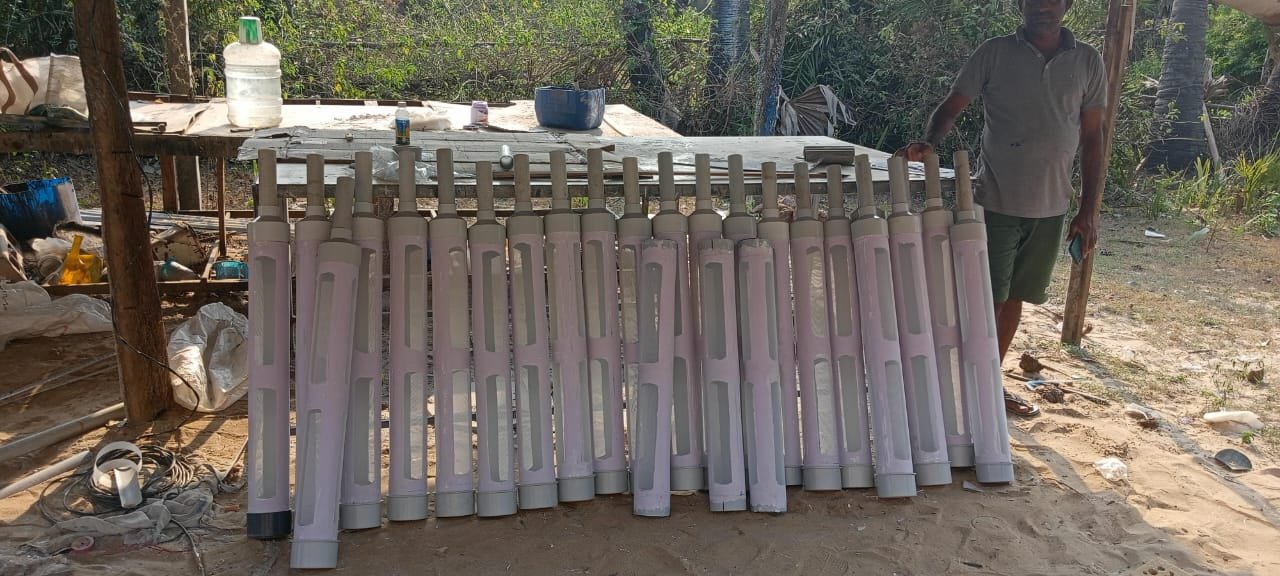
Custom FRP machine guard fabrication
Disciplined Methodology

The 6-Stage Custom Composite Fabrication Protocol

Every custom component manufactured in our Visakhapatnam works follows a rigorous 6-step engineering discipline.

01

CAD Modeling & Scoping

Detailed dimensional measurement on site, 3D CAD modeling, draft angle optimization, and structural laminate thickness calculation.

02

Resin & Fiber Formulation

Selecting optimal thermoset resin chemistry (Vinyl Ester Novolac, Bisphenol, Epoxy) and reinforcement schedules (C-Glass veil, CSM, Woven Roving).

03

Pattern & Mould Tooling

Constructing high-accuracy wood, high-density foam, or composite split-mould tooling with high-gloss mirror release finishes.

04

Lamination & Controlled Cure

Applying the 90% resin chemical barrier veil followed by multi-ply structural glass laminations under temperature and humidity control.

05

CNC Trimming & Edge Sealing

Precision edge trimming, drilling mounting holes, sealing all cut glass edges with pure resin, and applying UV-resistant gelcoats.

06

QA Testing & Commissioning

Executing ASTM D2583 Barcol hardness testing, spark holiday testing (10 kV), and dimensional verification before dispatch.

Custom Applications

Custom FRP Components We Regularly Fabricate

Delivering high-precision custom composite mouldings for process plants and maritime operations.

Machinery Guards & Pump Splash Shrouds

Lightweight, split-mould protective covers for rotating slurry pumps, conveyor drive belts, centrifuges, and motor rain canopies with transparent inspection ports.

Clarifier Launders, Weirs & Baffles

Custom curved V-notch weir plates, scum baffles, and effluent collection launders for municipal wastewater and industrial effluent treatment plants.

Marine Boat Wheelhouses & Deck Cabins

Moulded navigation wheelhouses, steering consoles, insulated fish hold boxes, and aerodynamic deck canopies for commercial fishing vessels and workboats.

Non-Standard Chemical Reaction Vessels

Custom rectangular dip tanks, electroplating pickling vats, crystallization troughs, and chemical neutralizing sumps with internal dividers.

Fan Cowls & Duct Transition Hoods

Aerodynamic composite inlet bellmouths, cooling tower fan cylinders, duct square-to-round transitions, and acid exhaust damper housings.

Electrical Substation Enclosures

Dielectric, non-sparking, weather-tight enclosures and protective transformer barrier screens for high-voltage switchgear yards.

Tooling & Mold Engineering

Custom FRP Component Fabrication: Pattern Making, Tooling Physics & Tolerances

An encyclopedic technical manual on composite mould design, thermal shrinkage compensation, exotherm management, and reverse-engineering of metal components.

1. Master Pattern & Mould Tooling Physics

Custom composite component fabrication begins with the creation of precision master plugs and multi-piece female/male molds. Tooling is constructed using zero-shrinkage vinyl ester tooling resins reinforced with high-density multiaxial glass fabrics to guarantee dimensional stability over hundreds of production molding cycles.

2. Thermal Shrinkage & Exotherm Kinetics

During thermoset polymer polymerization, volumetric resin shrinkage ranges from 1.5% to 4.0% depending on resin chemistry and filler content. Our pattern engineers apply precise volumetric compensation factors (typically 1.008 to 1.015 expansion ratio on master CNC plugs) to ensure finished composite components meet exact CAD specifications (± 0.5mm).

3. Reverse-Engineering Metallic Machinery Parts

When original manufacturer parts are obsolete or failing rapidly from acid corrosion, our engineers digitize the physical geometry of corroded cast iron, mild steel, or aluminum components (pump shrouds, machine guards, clarifier weirs) using 3D coordinate scanning and generate custom FRP molds for permanent composite replacement.

4. Engineering Dimensional Tolerances

Component Dimension Hand Lay-Up Tolerance Resin Infusion (VARIM) Matched Tooling / CNC
Linear Dimensions (< 1000mm) ± 1.5 mm ± 0.8 mm ± 0.3 mm
Large Dimensions (1000 – 5000mm) ± 3.0 mm ± 1.5 mm ± 0.8 mm
Laminate Thickness ± 10% ± 5% ± 3%
Flange Flatness & Squareness ± 1.0 mm/m ± 0.5 mm/m ± 0.2 mm/m

Standards Compliance & Verification

  • ASTM D2583: Barcol Hardness verification across all molded surfaces.
  • ASTM D5162: High-voltage spark testing for continuous monolithic barrier integrity.
  • BS 4994: Specification for design and construction of custom composite components.

Have a Custom Component Drawing or Broken Part to Replace?

Send our Visakhapatnam tooling specialists your 2D/3D CAD drawings or component photos for rapid quotation and pattern tooling schedule.

Mould Tooling Manual

In-House Pattern Making, Master Plug Construction & Production Tooling

Precision craftsmanship, split-mould split lines, release agent chemistry, and vacuum bagging optimization.

1. Master Plug & Pattern Engineering

The dimensional precision and surface finish of a finished composite part depend 100% on the quality of the initial master plug. Our pattern makers construct dimensionally stable plugs using high-density polyurethane (PU) tooling board, precision-cut marine plywood, or CNC-machined EPS foam coated with tooling paste.

Plugs are sanded to a mirror finish (up to 2000-grit wet sanding) and coated with high-gloss vinyl ester tooling primer before applying semi-permanent polymeric release agents. Draft angles are engineered with a minimum of 1.5° to 3.0° to ensure effortless part demoulding without surface scuffing.

2. High-Durability Production Tooling Moulds

For high-volume or repeated component manufacturing (such as clarifier weir plates, machine guards, or boat cabins), we build dedicated heavy-duty production moulds using zero-shrinkage vinyl ester tooling resins reinforced with heavy woven rovings and structural steel stiffening frames. Tooling moulds feature high thermal stability, allowing them to withstand exothermic curing temperatures up to 80°C without warping or print-through.

3. Fast-Track Prototyping for Emergency Plant Shutdowns

When unexpected equipment failures threaten plant operations, our Visakhapatnam tooling shop offers fast-track 48-to-72 hour rapid prototyping. We can take damaged metallic pump covers, fan cowls, or valve shrouds, digitally reconstruct geometry, build temporary sacrificial tooling, and deliver fully cured composite replacement parts within days, preventing costly prolonged plant shutdowns.

Tooling & Moulding Manual

Comprehensive Custom Moulding Science, Release Systems & Post-Curing Schedules

Engineering precision, split mould design, vacuum bagging protocols, and thermal post-curing cycles.

4. Exothermic Curing Control & Thermal Peak Management

During thermoset esterification, free-radical polymerization is highly exothermic, releasing up to 350 kJ/kg of heat. In thick composite sections (such as heavy flange hubs or thick machine guard mountings), uncontrolled peak exotherm temperatures can exceed 140°C, leading to resin boiling, internal micro-cracking, and severe laminate shrinkage.

Our composite craftsmen manage exotherm buildup through staggered multi-stage lamination schedules, applying no more than 3 to 4 plies of 450 gsm Chopped Strand Mat per lamination pass, allowing natural cooling between consolidation stages to preserve absolute structural integrity.

5. Post-Curing Temperature Profiles & Glass Transition (Tg)

To achieve maximum chemical corrosion resistance and elevated heat deflection temperatures (HDT), all vinyl ester and epoxy composite components undergo controlled thermal post-curing. The component is heated in our climate-regulated curing bay according to a disciplined ramp-soak-cool cycle:

  • Initial Cure: 24 hours at ambient workshop temperature (25°C–30°C) to reach preliminary green cure.
  • Thermal Ramp: Temperature elevated at a controlled rate of 10°C per hour up to 80°C.
  • Soak Period: Held continuously at 80°C for 4 to 6 hours to drive conversion of remaining unreacted styrene monomer bonds (≥ 98% cross-linking density).
  • Controlled Cooling: Cooled at ≤ 15°C per hour back to ambient to eliminate residual thermal stress concentrations.
Precision Moulding Manual

In-Depth Tooling Design, Split-Mould Mechanics, Vacuum Bagging & Quality Inspection

Master plug construction, vacuum bag consumables, resin degasification, and CNC trimming protocols.

6. Precision Split-Mould Design & Split Line Engineering

Complex geometric components—such as double-curved pump splash hoods, centrifugal blower housings, boat consoles, and multi-port valve shrouds—cannot be demoulded from single-piece female moulds due to positive draft angle locking.

Our tooling craftsmen engineer multi-piece split composite moulds featuring:

  • Interlocking Precision Split Flanges: Minimum 75 mm wide split flanges reinforced with steel box frames and fitted with precision guide alignment dowel pins, guaranteeing repeatable seam alignment (± 0.5 mm).
  • Silicone O-Ring Vacuum Seals: CNC-machined perimeter grooves carrying continuous silicone or elastomeric cord seals, allowing the split mould to maintain ≥ 0.95 bar vacuum for vacuum infusion processing.
  • Semi-Permanent Polymeric Release Coatings: Micro-thin polymeric release films chemically bonded to the mould surface, delivering mirror-gloss finishes without wax transfer or styrene buildup.

7. Vacuum Bagging Consumables & De-Airing Optimization

In high-performance contact moulding and vacuum infusion, achieving void-free laminates requires disciplined vacuum consumable layup: nylon peel ply fabrics for secondary bonding preparation, perforated release films, high-permeability resin flow distribution meshes (green mesh), and flexible nylon vacuum bagging films (elongation > 400%).

Vacuum pressure is monitored continuously using digital absolute vacuum gauges with automated ultrasonic leak detection, ensuring that zero atmospheric air ingress occurs during liquid resin infusion.

8. CNC Trimming, Drilling & Edge Resin Encapsulation

After demoulding and initial green cure verification, composite components undergo final dimensional finishing using diamond-tipped CNC routers, waterjet cutting, or precision jigs. All mounting bolt holes are drilled with zero fiber tear-out or interlaminar delamination.

Critically, every single cut glass edge, drilled bolt hole, and machined notch is immediately brush-coated with pure catalyzed Vinyl Ester resin. This total edge encapsulation seals exposed glass capillaries against environmental moisture wicking, preserving 100% mechanical strength over the component’s operating life.

Comprehensive Tooling Manual

In-Depth Custom Component Engineering, Composite Plug Craftsmanship & QA Testing

From initial 3D digital photogrammetry and master pattern construction to exothermic heat dissipation and Barcol verification.

9. Digital 3D Photogrammetry & Reverse Engineering of Damaged Metal Equipment

In operating chemical process plants, aging carbon steel slurry pump casings, centrifugal fan cowls, and clarifier launders frequently corrode or crack beyond repair, often after original OEM equipment manufacturers have discontinued legacy replacement models or demand 6 to 9 month import lead times.

Our Visakhapatnam engineering team executes rapid reverse engineering directly on site:

  • 3D Optical & Laser Scanning: High-precision optical 3D scanners capture complex physical geometries with accuracy down to ± 0.05 mm, capturing critical mounting bolt hole patterns, shaft centerlines, and internal fluid flow profiles.
  • Parametric CAD Reconstruction: Point cloud scan data is imported into parametric 3D CAD platforms to eliminate casting distortions, optimize draft angles for mould release, and add structural reinforcing composite ribs in high-stress zones.
  • Rapid CNC Master Plug Milling: High-density polyurethane tooling foam is milled directly from CAD geometry on 5-axis CNC routers, allowing precision master moulds to be built and cured in days rather than months.

10. Comprehensive Material Property Verification & Inspection Dossier

Every custom component leaving our fabrication bays is accompanied by a formal Quality Assurance Inspection Report detailing:

  • ASTM D2583 Barcol Hardness Certification: Minimum 10 random indentation test points confirming full ≥ 98% polymer matrix cure.
  • ASTM D5162 High-Voltage Spark Test Certificate: 100% surface scan at 10 kV DC proving zero micro-porosity in chemical barriers.
  • Dimensional Inspection Report: Laser-verified dimensional compliance against approved client general arrangement drawings.
Tooling Engineering Manual

Comprehensive Quality Inspection Gateways & Post-Curing Documentation

From initial raw material inspection and resin viscosity logging to Barcol hardness certificates and final shipping protection.

11. In-House Non-Destructive Testing (NDT) Protocol for Custom Parts

Every custom component manufactured in our Visakhapatnam works undergoes a multi-point non-destructive testing regimen before client acceptance sign-off:

  • Barcol Indentation Hardness (ASTM D2583): Certified at 10 random points on both the mould contact face and structural back face, ensuring minimum Barcol hardness of 40 (equivalent to > 90% full cross-link conversion).
  • Spark Holiday Testing (ASTM D5162): 100% surface scan of all chemical contact faces using a high-voltage 10 kV DC brush tester to prove zero micro-pinholes or porosity.
  • Ultrasonic Laminate Thickness Verification: Continuous composite ultrasonic wall thickness gauging to verify that all structural ribs, flanges, and shell walls meet or exceed design drawing dimensions.
  • Surface Gelcoat Gloss & UV Color Fastness: Spectrophotometer and gloss meter verification ensuring uniform color and UV stabilizer dispersion.

12. Custom Tooling Preservation & Lifetime Re-Order Archiving

All master split moulds and tooling plugs built for client projects are serialized, cleaned, treated with protective storage wax, and cataloged in our climate-controlled tooling warehouse. This allows our industrial clients to re-order identical replacement components, machine guards, or clarifier weirs with zero new tooling costs and immediate turnaround times.

13. Precision Tolerances & Custom Mould Fabrication Standards

All bespoke composite mouldings fabricated in our Visakhapatnam facility comply with strict dimensional tolerances per DIN 16901 / ISO 2768-m. Critical mounting surfaces, flange faces, and bearing mountings are held within ± 0.5 mm to ± 1.0 mm, guaranteeing seamless mechanical integration into existing plant equipment trains without requiring site modifications.

Our tooling engineers utilize coordinate measuring arms and laser distance meters to verify geometric fidelity against client 3D CAD models before dispatching finished equipment.